
A Bronze Age shield has returned to Scotland for the first time in more than 230 years.
The shield was discovered during labouring work near Beith in North Ayrshire around 1779, and in 1791 was presented to the Society of Antiquaries of London where it remained ever since.
It has now been brought back north of the border on loan for the first time ahead of the Scotland's First Warriors exhibition, which opens at the National Museum of Scotland (NMS) in Edinburgh this summer.
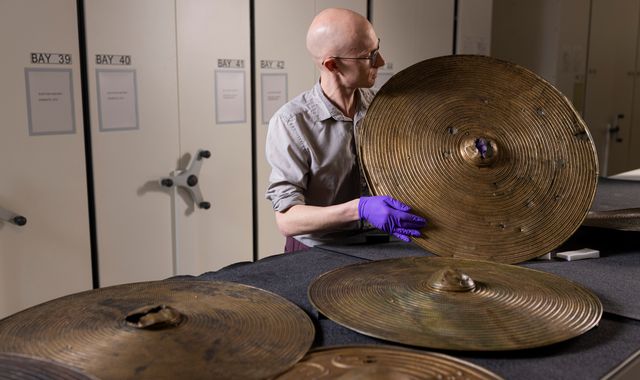
Ahead of the show it was brought together with five other shields, discovered in the Borders and Aberdeenshire in the 19th century, which are part of the NMS collection.
Four of the shields, including the one from Beith, will feature in the exhibit - but bringing the six together beforehand has given experts the opportunity to compare the craftsmanship of the items, which date from 3,300 to 3,500 years ago.
Dr Matthew Knight, senior curator of prehistory at NMS, said: "The moment the sixth shield arrived back in Scotland and was unpacked at the National Museums Collection Centre was breathtaking.
"The Beith shield is such a spectacular, intricate object and thanks to the generosity of the Society of Antiquaries of London, this is the first time it has been seen in Scotland since its discovery over 200 years ago.
"Bronze shields from this period are exceptional to Britain and by bringing all six of these incredibly rare shields together, we can gain a deeper understanding of life and conflict in Bronze Age Scotland and beyond.
"It really is a once-in-a-lifetime opportunity."
According to historical reports, the shield was discovered with five or six others buried upright in a circle in the peat.
Measuring around 60-70cm in diameter, the shield is decorated with hammered bosses and ribs, and has spear damage - indicating it was used in combat.
It is not known why the group of shields was buried in this way.
Dr Knight said of the Beith shield: "We know that because they're so hard to make and they're quite rare objects, whoever owned it was probably someone of quite high status, or they would have been quite special.
"When you think about the idea that it was one of five or six that were buried in a bog, it makes you think that there must have been this group of high-status people who came together to bury their shields together.
"We can only speculate about what that sort of ceremony might have been like, or what the meaning behind it would have been, where maybe this was a group of communities who were giving up their defensive objects.
"Perhaps it was a sign of peace."
Dr Knight said most of the shields look very similar, potentially suggesting they were made by the same craftsperson or workshop.
Wooden or leather shields were more common at the time and it is believed the rare bronze ones were used not only for defence but also symbolised the status of the warriors they belonged to.
Read more from Sky News:
'Fascinating' personal library of 'forgotten scholar' rediscovered
Scotland's last shoemaking shop 'frozen in time' to be restored
Scotland's First Warriors exhibition will explore thousands of years of history, from the Neolithic (late Stone Age) to the coming of the Romans.
It will also feature internationally significant archaeological discoveries from across the nation, such as the Carnoustie Hoard, which includes a rare spearhead decorated with gold and a bronze sword in a wooden scabbard, dating from around 1120-920 BC.
The exhibition opens on 27 June and will run until 17 May 2027.

(c) Sky News 2026: Bronze Age shield returns to Scotland for first time in more than 230 years
 Radio 2 DJ Scott Mills sacked by BBC over 'personal conduct'
 Arnold Schwarzenegger returns to Belfast to receive honorary doctorate
 Russell Brand's rape trial delayed for six months
 Oscars to leave Hollywood - organisers announce move to downtown Los Angeles for 2029