

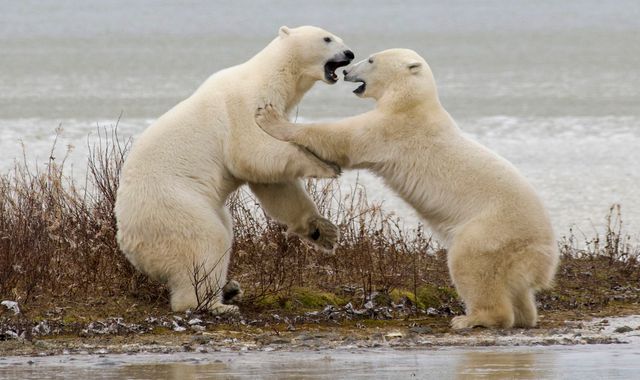
Artificial intelligence-powered "doorbell cameras" are being tested by a team of international experts in Canada to warn communities about approaching polar bears as climate change increases the risk of dangerous encounters.
The device, called Bear-vision, combines radar and cameras to sense motion in the surrounding Arctic landscape before identifying and monitoring any animals nearby.
It is being trialled at a waste facility in Churchill, a northern town on the coast of Hudson Bay in the Canadian province of Manitoba.
The new tool is among several solutions being developed by conservation group Polar Bears International to alert homes and businesses to approaching bears.
Data gathered will train the camera to send notifications whenever it detects a polar bear, and help prevent surprise encounters.
"Imagine a doorbell camera that tells you if a polar bear is outside," said the organisation.
The aim of the venture is to protect both people and animals - and help the community manage and monitor the area, as polar bears gather nearby and wait for the bay to freeze over to hunt seals, and thousands of tourists arrive to see the animals.
The conservation group said the animals are waiting on land for about a month longer because of climate-driven ice loss.
Polar Bear Week 2026 - hosted by the organisation - begins on Sunday to coincide with the gathering of the bears.
More from Sky News:
Could AI really create a bioweapon?
Crypto industry suffers 'largest bank heist in human history'
'Manosphere' as bad as tobacco for public health, report warns
Tests are being carried out at the Churchill waste facility after a fire in 2024 destroyed the site and attracted polar bears searching for food.
Krista Wright, executive director of Polar Bears International, said: "We're grateful to the Churchill community, who we've been honoured to work with over the decades on human-polar bear co-existence, ensuring that conservation benefits not just wildlife but the community too.
"We're experiencing first-hand how co-existence is becoming part of everyday life in more places."
The conservation group is also working on a separate research project with Brigham Young University in Utah to test drones as an affordable and non-lethal way to move bears away from communities safely.
This deterrent initiative is also testing ultrasonic sound, conductive materials, and a new odour-based bear spray formula.

(c) Sky News 2026: AI-powered 'doorbell cameras' tested to cut risk of rising human encounters with polar bears
 Crypto industry suffers 'largest bank heist in human history' as billions stolen in Binance hack
 'I woke up confused and in pain': Christa Pike describes moments after botched execution
 Poundland bidder tells administrator it remains keen on rescue deal
 Meta, TikTok and X lose hearing against UK watchdog over moderation data demands
 Banished: The Taliban's War On Women - tickets go live for Alex Crawford documentary screening
 Manosphere content poses danger to public similar to tobacco, report warns
 UK student pilot among three killed in mid-air helicopter collision in Oregon