
The cosmos is set to put on a show later this week when a celestial event reaches its peak.
The Eta Aquariid meteor shower will reach its crescendo between midnight and dawn on Wednesday.
British stargazers will have the best chance of witnessing the shower closer to dawn at locations removed from streetlamp and other light pollution.
Eta Aquariid is active between 19 April and 28 May this year, according to Royal Museums Greenwich (RMG).
The astronomical event is associated with Halley's Comet, which passes by Earth about every 76 years on its trip around the sun.
What is a meteor shower?
Meteor showers occur when the Earth moves through trails of debris left behind by comets or asteroids every time they come close to the sun.
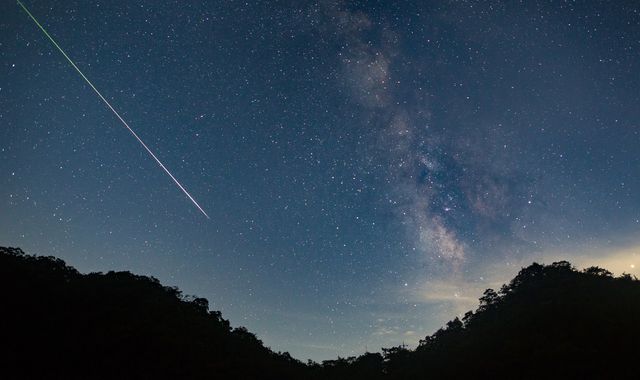
These fragments collide with the Earth's atmosphere at extremely high speeds of up to 43 miles (70km) per second, producing streaks of light as they vaporise.
We call these meteors or shooting stars.
The Eta Aquariids shower is one of two created by debris from Halley's Comet, which last visited the inner solar system in 1986.
The other phenomenon is the Orionid meteor shower which comes in October.
The "beautiful streaks" appearing in the sky can be caused by particles as small as a grain of sand, the RMG said.
While on any given night a spattering of meteors can be seen, meteor showers offer a more exciting spectacle.
How can I see Eta Aquariids?
The meteor shower will be most visible in the UK in the early pre-dawn hours on Wednesday in the eastern sky.
This is because the shower favours the Southern Hemisphere, meaning it will appear low in the sky.
However, this year a bright waning gibbous moon on Wednesday will result in less favourable viewing conditions.
Despite this, some meteors are still likely to be seen in the early hours of the morning.
As the moon rises just after midnight, conditions will also be favourable before then.
Experts caution meteor spotting is a waiting game, so celestial enthusiasts are advised to bring a comfy chair and rug up.
"Hunting for meteors, like the rest of astronomy, is a waiting game, so it's best to bring a comfy chair to sit on and to wrap up warm as you could be outside for a while," RMG said.
"They can be seen with the naked eye so there's no need for binoculars or a telescope, though you will need to allow your eyes to adjust to the dark."
This meteor shower has no sharp peak but instead a plateau of good rates that last approximately one week centred on 6 to 7 May.
What does Eta Aquariids look like?
To viewers, Eta Aquariids will look like bright streaks against the night sky.
"You're looking for bright streaks that appear in the corner of your eye for a fraction of a second," said astrophysicist Nico Adams with SSP International, a non-profit that promotes STEM education.
Teri Gee, manager of the Barlow Planetarium in Wisconsin, said there was no better way to experience Eta Aquariids than to see it yourself.
"It almost feels like you're discovering it yourself," she said.
Where does its name come from?
The meteor shower is named after the constellation in the night sky that it appears to radiate from, the Aquarius constellation.
More specifically the meteor shower is named after one of the stars in this constellation: Eta Aquarii.

(c) Sky News 2026: 'Beautiful streaks': Eta Aquariids meteor shower to light up skies over Britain
 King 'delighted' as Princess Eugenie announces she is expecting her third child
 At least 12 wounded after Oklahoma party shooting
 Former New York City mayor Rudy Giuliani in 'critical but stable condition' in hospital
 Tens of thousands of cancer patients to benefit from one-minute NHS jab
 Peter Kay show bomb hoax suspect removed from court after outbursts during hearing
 Food price inflation still rising, as lower income households feel the squeeze, study says
 SAG-AFTRA reaches tentative deal with studios, in bid to avoid strikes
 Fish, eels and birds killed in suspected River Spey tributary pollution incident