
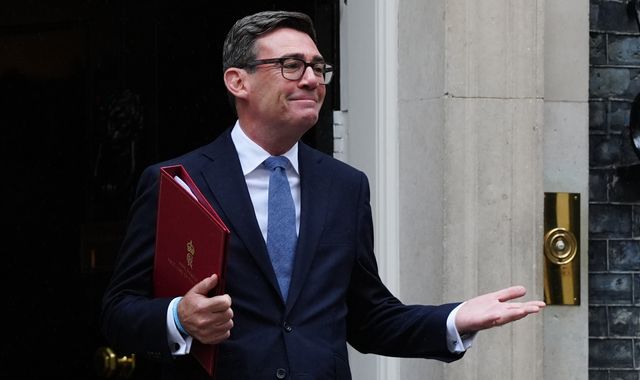
Labour return to Liverpool this week for their first annual conference under Andy Burnham's leadership.
The party have high hopes for recovery under their new leader, who has made a strong first impression with MPs and voters alike.
But turning around Labour's fortunes is a huge task, as the final months of Sir Keir Starmer's premiership saw the party fall to record lows in polls and election results.
The new prime minister needs to achieve three things: Improve Labour's headline polling, recover his party's standing against its two large right-wing opponents, and reunite the left vote by recovering disaffected progressive voters lost during the Starmer years.
He has made some headway on all three fronts but there is a long way to go yet.
A grim inheritance: Labour's collapse in Starmer's final months
Sir Keir Starmer ended his time in Downing Street with the worst ever final approval rating for a Labour leader since 1977.
Just 17% were satisfied with Starmer while 76% were dissatisfied, a net approval of -59, worse than the -51 final rating for Michael Foot and the -49 recorded by Jeremy Corbyn.
Labour's election showings in Starmer's final months were also awful.
The governing party lost crunch by-elections in Caerphilly last October and in Gorton & Denton in February, falling to third place in two former strongholds.
In both campaigns, Labour was marginalised by progressive parties on the left, with both Plaid Cymru and the Greens successfully framing themselves as the best placed local opponent to Reform.
This May's local and devolved elections were even worse, setting multiple unwanted records.
Labour managed just 17 seats in the Scottish Parliament, a record low, and fell to third place in Wales, a country it had governed for all of the 27 years since devolution began.
In English local elections, Labour also suffered a record-breaking collapse, losing nearly 1,500 council seats, more than half of those it was defending, and the party's share in the National Equivalent Vote fell to just 15%, a new record low.
Labour lost control of 40 councils this year, including many town halls in heartland areas the party had hitherto dominated for decades.
The only electoral bright spot in Starmer's final months was delivered by Andy Burnham, who demonstrated his greater electoral appeal by handily winning the Makerfield constituency on an increased share of the vote, just a month after all its constituent wards had elected Reform UK councillors.
It was this emphatic win that helped convince Labour MPs to hand Burnham the keys to Downing Street.
Headline polling: A Burnham bounce?
Labour were in deep trouble in the polls when Burnham arrived.
Polls conducted in Sir Keir Starmer's final weeks put Labour support under 20%, a floor the party had never fallen below before. Burnham has managed a swift turnaround, but the job is still only half done.
Labour secured average headline vote shares of 26% in polls conducted over the month running up to the party conference, a seven point rebound on the low recorded before Starmer's departure.
This poll bounce has been sufficient for Labour to retake the lead for the first time since early 2025. But this return to first place owes as much to Nigel Farage's recent woes as Andy Burnham's appeal.
Labour may be up off the floor again but they are still nine points behind the share achieved in the 2024 general election - itself the lowest share ever recorded by a party winning a Commons majority.
There is a bigger "Burnham bounce" in leader approval polling.
An average of 38% of respondents approve of Andy Burnham across polls from the seven pollsters who ask approval questions regularly, almost double the 20% approval Sir Keir Starmer managed in his final polls.
An average of 32% currently disapprove of Burnham's performance, half the 64% share of voters who disapproved of Starmer in June.
Burnham's early ratings look less impressive if we take a longer view.
The new prime minister's second rating with Ipsos, who have asked this question since 1977, is only a little better than those his recent predecessors (except Liz Truss).
Andy Burnham's early approvals are worse than all the new prime ministers from Margaret Thatcher to Theresa May, and nowhere near the exceptional early satisfaction ratings Tony Blair and John Major achieved in the 1990s.
Issues and performance: Can Burnham deliver?
Andy Burnham tends to do better on questions which ask voters whether they like or approve of him personally than those asking how good a job he is doing. And voters' ratings are even worse when pollsters ask them how well they think the government is doing.
For example, 50% of those polled most recently by Ipsos said they liked Andy Burnham, but only 31% report to the same pollster they are satisfied with the job Burnham is doing as prime minister, and only 18% were satisfied with the way the government is running the country.
This pattern underlines the second test Andy Burnham faces - many voters like the new prime minister yet remain unconvinced he and his government can deliver.
The agenda facing Andy Burnham in his early months is largely the same as his predecessor confronted a year ago. Immigration, the economy and health form the top tier of voter priorities, now and then.
If Andy Burnham's personal honeymoon is to last, he needs to instil faith in voters that his government can do a better job delivering on these issues than the two right-wing parties, Reform UK and the Conservatives, vying to unseat him at the next election.
The pollster Opinium regularly asks voters whether they think Labour or one of these two opposition parties would do at better job at handling a list of top political issue.
Labour's leads over the Conservatives are larger now with Burnham in charge than they were last year under Starmer. In particular, Labour now have bigger leads on the economy, the NHS and immigration - the three issues highest up the agenda for most voters.
Labour's leads over the Conservatives on the left's traditional core issues of education, housing and inequality have also grown.
But weaknesses remain. Labour has smaller leads over the Conservatives on security issues - defence, crime, terrorism and foreign affairs - and the party's position on these issues is no better now than it was a year ago.
And there is a broad problem - many respondents tell Opinium they think neither party can handle most of the issues asked about.
Labour's has made bigger gains in comparisons with Reform UK. A year ago, voters saw Reform as better able than Labour to address immigration, crime, terrorism and defence, while Sir Keir Starmer's Labour had only low single digit leads over Nigel Farage's party on most other issues.
The picture is very different now, with Labour now strongly preferred to Reform on almost every issue.
Burnham and Labour now lead by 20 points or more on the crucial issues of the economy and the NHS, while fighting Reform to a draw on the latter's core issue of immigration, where Reform had an 18 point advantage a year ago.
However, Labour's leads are smaller on the security agenda - crime, terrorism and defence - and the mood shift here may be driven as much by Reform's recent retreat as Labour's Burnham bounce.
And, as with the Conservative comparisons, many respondents have no faith in either party to address many of the issues asked about.
Fragmentation: Can Burnham reunite the left?
Losses to parties on the left were a major driver of Labour's polling decline under Sir Keir Starmer, and if Andy Burnham is to turn around Labour's fortunes, he needs to win these voters back.
Burnham has already made some progress.
In the final weeks of Starmer's leadership, less than half of 2024 Labour voters told YouGov intended to back the party again, while over a third were said they now preferred another party on the left. In the most recent YouGov poll, Labour retains over 60% of its 2024 vote, while under a quarter back other left wing parties. Losses to the right are unchanged (15% vs 16%).
The same pattern is true from the other direction. In Starmer's final weeks, only 5% of 2024 Liberal Democrat or Green voters said they would now back Labour. In Burnham's most recent polling Labour gains have risen to 10% among 2024 Lib Dems and 16% among 2024 Greens.
Voters who backed other left parties in 2024 also have much more favourable views of Burnham now than they did of Starmer.
Four in every 10 2024 Liberal Democrat voters had a positive view of Starmer in June; more than six in 10 now have a positive view of Burnham. Less than three in 10 past Green voters liked Starmer in June, but nearly half like Burnham now.
A recent study of tactical voting intentions by YouGov also suggests a growing willingness among progressive voters to coalesce behind Labour to see off right-wing competitors, with a particularly sharp rise in the willingness of Green voters to lend their support to Labour where the latter is best placed to see off a Reform or Tory challenge.
The recent MRP conducted by YouGov for Sky News underlines just how important such tactical voting may prove. Labour finish second place in 173 seats in this MRP.
Labour can gain more than a half of these seats with tactical votes from a third of current Green and Lib Dem supporter. And Burnham's party could win 131 of the 173 seats if two thirds of the other progressive parties' voters tactically switch.
Burnham's greater attractiveness to tactical switchers could therefore be crucial, as tactical voting may be the key to a majority at the next general election.
A good start, but the real tests are yet to come
Andy Burnham has made some progress in dragging his party out of the hole left by his predecessor since taking office in late July.
Burnham's early approval ratings are mostly positive, Labour has improved its standing versus right-wing competitors, and the new Labour leader has made headway in recovering Labour's losses on the left.
But the going gets tougher from here. Burnham's appeal to progressive voters will be tested for the first time on 8 October as he seeks to fend off a challenge from the Green leader Zack Polanski and hold on to his predecessor's seat of Holborn and St Pancras.
Three weeks after that, the new Chancellor John Healey will deliver his first budget. With bond markets restive, public services creaking, energy supplies threatened, and inflation nudging upwards, it is hard to see how the new chancellor can avoid inflicting some pain on voters.
Either taxes will have to go up, or promised improvements will be deferred and watered down. Or, most likely, a bit of both. After the budget, winter will set in and the latest spike in energy prices will start to bite.
These will be tougher tests. Hope and change are easier to sell when you are showering money on things voters like, while delaying or watering down things they don't.
Selling voters on the need for sacrifice and compromise is harder. As the new prime minister takes to the stage in Liverpool, there is a newfound sense of hope among the Labour faithful. He, and they, should enjoy the moment - it may not last.
This is the third in a series of posts reviewing the polling and electoral performance of the parties as they gather for their annual conferences. Previous posts have covered the performance of Reform UK and the Liberal Democrats

(c) Sky News 2026: This Charming Man: Can Andy Burnham restore Labour's fortunes?
 Ireland players refuse handshakes before Nations League win over Israel
 Avanti to be nationalised 'to build railway that actually works for people'
 Two mass shootings kill at least 27 people in South Africa
 Buyout firm Advent eyes Monzo stake amid £10bn Nubank bid talks
 Spain housing crisis protest after 87-year-old woman evicted