
David Gwynn isn't happy with how his job interview at a London hospitality agency went last month.
The 37-year-old didn't feel listened to, got no feedback and found the whole process "incredibly alienating".
That's because he'd been interviewed by a robot.
It was that or facing a month-long wait to meet a manager.
Gwynn is one of an increasing number of job seekers facing a non-human interviewer as recruiters turn to AI to tackle an overwhelming number of candidates.
"Being interviewed by an AI bot felt incredibly alienating - there's no feedback or human interaction, so you have no idea how you're coming across," says Gwynn, a part-time bartender.
More than four in five hiring managers are deploying some form of AI in the application process, according to CV-Library data shared exclusively with the Money team.
At the same time, 40% of job seekers have either abandoned or considered abandoning an application due to AI being used in the hiring process, the CV-Library research found.
Gwynn compared the experience to Harrison Ford's 1982 dystopian sci-fi blockbuster, Blade Runner.
"It feels like you're being filtered out, and with so little real communication, it's easy for the effort you put in to be completely overlooked."
Behind the rise of the robots
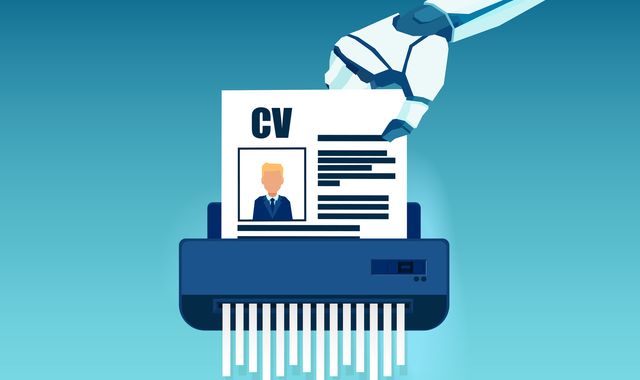
Faced with an explosion in the number of applicants, recruiters are turning to AI to schedule calls or sift CVs, administer or score assessments, take interview notes or even carry them out.
The number of applications per job posting soared by 286%, from 13 to 49 in the year to November 2024, according to the latest available data from recruitment platform Tribepad.
And the number of vacancies per 100 jobs almost halved from 4.1 to 2.2 between May 2022 and February 2025, data from the Office for National Statistics shows.
AI appears to be at fault here, too - but not employers.
"Applicant volumes are going through the roof because candidates are using AI to write cover letters, write resumes and apply," says Dina Taylor, a senior executive and AI chief at Hirevue, which offers hiring services, including AI tools, to employers.
The company counts Walmart, Nestle, William Hill and multiple universities among its customers - but it would not disclose which of its clients are using specific AI tools.
Taylor adds: "No recruiter or hiring manager has the brain space or the time to read all of those resumes and make an informed decision. And every day that the job goes unfilled is lost dollars to the business."
Nearly 80% of the 500 employers surveyed by CV-Library said AI-generated applications have surged in the past year.
Locked in an 'arms race'
While Gwynn understands the reasons recruiters are deploying AI, he says it speaks to a wider "imbalance" between companies and would-be workers.
Employers are demanding candidates jump through more and more hoops in a hiring process, with some of Gwynn's first-stage applications taking more than three days to complete: "You really pore over it and then what you get back is basically nothing."
More than half (53%) of 1,100 applicants surveyed believed their application had been rejected by AI without a human reviewing it.
Some bosses weren't impressed by the outcome either.
Read more from Money:
Is it time you got on to 'savings laddering' trend?
Why millions of Britons are off work long-term sick
Britons using refund trick to steal meals and goods
CV-Library's data shows 72% of hiring managers felt AI struggled to identify a cultural fit, and 55% said it performed poorly at assessing soft skills.
Lee Biggins, chief executive at CV-Library, says its research is a "wake-up call" to recruiters that they must use AI to support human intuition, not replace it.
"We're seeing the start of a vicious cycle. AI is being used to manage application volume, but it's also contributing to that volume - creating an 'arms race' where both employers and candidates are optimising for efficiency, but at the expense of quality.
"As the market gets more competitive, recruiters are under pressure to process applications faster, adding more AI-screening steps - filters, assessments, pre-questions - all of which make the process longer for candidates.
"In response, job seekers are turning to AI to apply at scale or optimise their applications. And so, the cycle continues."
Overall, 35% of employers felt they were missing out on the best hires due to AI's lack of human intuition.
'Use it to your advantage'
But Hirevue's Taylor pushed back on this figure, saying the findings were based on "assumptions or hunches".
"If you post a job and 1,000 people have applied for that job, I'd really challenge whether or not they actually spoke to all thousand."
Taylor said the most important thing for successfully deploying AI in hiring processes is tailoring it to assess the skills a specific company is looking for, "rather than a one-size-fits-all".
Bots that properly probe candidates can give them a better opportunity to sell themselves than a written application, she says.
"When you're a piece of paper being compared with another 999 people, that's so hard to have a chance to tell your story. Versus you're one of a thousand and you have a chance to have a conversation, even if it's a digital conversation, you're still surfacing more about yourself."
Taylor adds: "And the reality is, AI is becoming sort of a core skill that's being expected from people across the board."
She suggests candidates should "lean into it" and use an AI-powered application stage to their advantage to reach the next one.
Despite disliking the use of AI, Gwynn appears to have done just that, securing an interview with a human hiring manager.
Five top tips
CV-Library has shared five top tips to make sure AI doesn't filter out your application.
- Frontload your skills: Start your CV with clear bullet points that match the job description.
- Showcase unique achievements : Use active, measurable language to showcase your achievements. Highlight real results, not generic claims, so both recruiters and AI can recognise your impact.
- Tailor every application: Customise your CV and cover letter for each role. AI can help with formatting or phrasing, but show you understand the company and role.
- Be specific, not vague: Avoid relying on generic claims like "improved", "led", and "managed", and instead include data and context. AI systems spot quantifiable outcomes.
- Stick to simplicity: Avoid text boxes, images, graphics and tables as AI tools struggle to interpret them. Stick to simplistic layouts with basic styling, and clean, professional fonts like Arial or Calibri.

(c) Sky News 2026: Unemployed Britons turning up to job interviews to find the interviewer is an AI robot
 Trump swings from gushing praise for King to scathing criticism of Starmer in five-minute call with Sky News
 Customers to get refunds as AA driving schools fined £4.2m in first clampdown on illegal online pricing
 Two more men charged with murder after fatal stabbing of 21-year-old filmmaker
 NHS 'failing women and girls' and has 'appalling culture of medical misogyny', health secretary says
 Harry reveals he needed to deal with 'stuff from the past' before becoming a dad
 Badenoch calls for Axel Rudakubana's parents to be deported after damning Southport attack report
 UK 'can't succeed' says Trump - read full transcript of his Sky News interview
 More than 900,000 pensioners not claiming key benefit | Money newsletter