
Donald Trump is pushing for a number of psychedelic drugs to be used to treat medical conditions.
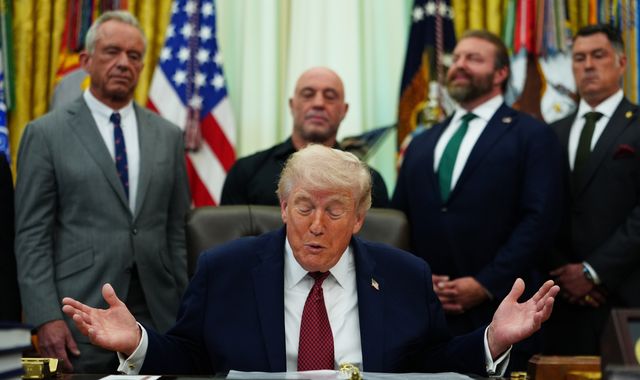
The US president signed an executive order speeding up reviews of the drugs on 18 April.
Among them is ibogaine, which is currently on the US government's ultra-restrictive list of illegal drugs, in a category which includes heroin.
But what is ibogaine and how close are the psychedelics to being approved?
What is ibogaine?
Ibogaine is made from a shrub native to West Africa and in high doses it can cause hallucinations.
It was first used by members of the Bwiti religion in African nations like Gabon during their religious ceremonies, but it has started being used in other countries as an alternative treatment for mental health conditions like severe depression and PTSD.
US veterans have reported benefiting from Ibogaine after travelling to clinics in Mexico that administer it, and the US president has said the move to accelerate treatments is "especially" to benefit them.
However, ibogaine can also cause dangerous irregular heart rhythms, which can be fatal if left untreated.
The substance has been linked to more than 30 deaths in medical literature, according to the Multidisciplinary Association for Psychedelic Studies, a non-profit that conducted some early studies in patients outside the US.
The National Institutes of Health briefly funded research on the drug in the 1990s, but discontinued the work due to ibogaine's "cardiovascular toxicity".
Clinics that administer the drug typically monitor patients' heart readings and have emergency medical equipment on hand.
Ibogaine is heavily restricted in the UK under the Psychoactive Substances Act 2016, making it a criminal offence to produce and supply it.
In the US, it is currently banned alongside other psychedelics, though some are being studied in large trials for various mental health conditions.
How do psychedelic treatments work?
Psychedelic treatments are used to activate proteins on the surface of nerve cells that regulate the brain's ability to reorganise, form new connections, and repair damaged circuits.
Rather than being taken at home, they are normally administered in clinics, with the patient being closely monitored.
While they are used to treat depression and PTSD, some early-stage trials are also testing psychedelic drugs for treating substance abuse disorders, borderline personality disorder, obsessive-compulsive disorders, anxiety, self-harm behaviour, chronic Lyme disease and fibromyalgia.
Risks are involved, with potential side-effects including acute anxiety, panic, and confusion during administration of the medicine, as well as short-term worsening of mood or distress.
Read more:
British-born man suspected of killing three people dies in US jail
Former Hollywood mogul facing new rape retrial
An estimated 10% to 15% of patients experience longer-term negative effects.
Psychosis or mania can also develop, especially in people with bipolar disorder or schizophrenia, while physical risks include nausea and headache with psilocybin, fatal cardiac arrhythmias with ibogaine, and transient increases in blood pressure, heart rate and body temperature with MDMA.
What does Trump's order mean?
The president's executive order was to speed up reviews of psychedelic drugs including ibogaine, with the aim of "dramatically accelerating" access to research and treatments.
"Today's order will ensure that people suffering from debilitating symptoms might finally have a chance to reclaim their lives and lead a happier life," the US president said in the White House on Saturday.
"If these turn out to be as good as people are saying, it's going to have a tremendous impact," he added.
The order calls on the Department of Health and Human Services to direct at least $50m to states that have enacted or are developing programmes to advance psychedelic drugs for serious mental illness.
It's a step towards easing restrictions, and while owners of ibogaine clinics have said the impact of the order will not be immediate, it is expected to encourage states to start introducing research on psychedelic drugs.
Tom Feegel of Beond Ibogaine, which operates a clinic in Mexico, told the Associated Press: "There will be no insurance coverage, it will still be considered unapproved and non-covered care.
"But what it does mean is that ibogaine shifts from being fringe and underground to being federally acknowledged."
The order comes after lengthy campaigning by veteran organisations and psychedelic advocates, including podcaster Joe Rogan, who was at the Oval Office when Mr Trump signed the executive order.
Health secretary Robert F Kennedy Jr has also championed the idea of using such drugs in the US.
The Food and Drug Administration is also set to issue national priority vouchers for three psychedelics, which the agency's commissioner, Marty Makary, says will allow certain drugs to be approved quickly "if they are in line with our national priorities".
The vouchers, which have any been issued for psychedelics, can cut review times from several months to a period of weeks.

(c) Sky News 2026: What is ibogaine? The psychedelic drug that Trump may make available
 Riot police to be deployed to stop small boat crossings
 Chelsea head coach Liam Rosenior sacked after fifth straight Premier League loss
 Singer D4vd's alleged murder victim died from penetrating injuries, post-mortem finds
 Two more arrested over arson attack plot targeting Jewish community
 Pope tells prisoners in Equatorial Guinea 'you are not alone'
 The robot that can outplay elite table tennis players
 Parents hail 'incredible' results after six-year-old girl has sight restored by gene therapy
 Christopher Trybus found not guilty of rape and manslaughter after wife Tarryn Baird took her own life