

There is a small fraction of the population for whom the release of the government's new Steel Strategy represents an extraordinarily fascinating, not to mention important, moment. The chances are you are not one of those people.
However, allow me to make the case that this document published by the government today represents something very important for all of us. And the reason, surprising as this might sound, has nothing to do with steel.
The strategy itself is, for those of us interested in such things, a big moment for the steel sector. There will be more money given out to steel producers - about £2.5bn - some of it going to the British Steel works in Scunthorpe that have been effectively nationalised, some going to support private steel makers around the UK in their efforts to produce lower carbon metal.
Money latest: Another major airport whacks up drop-off fees
Perhaps the most interesting of all the ambitions contained within it is a pledge to try to raise the proportion of steel we use in this country that is also made in this country. Right now that proportion is running at a record low of 30%, which, when you think about it, is rather depressing.
Think of all those wind turbines dotting the countryside and offshore, or for that matter much of the infrastructure surrounding us. Most of that still is not made - indeed cannot be made - in the steelworks and with the steel equipment we have in this country.
The ambition of the strategy is to raise the proportion of domestically produced steel to 50%, which is certainly better than the current level but is basically back to the level that used to prevail before COVID.
However, a far more significant element of the Steel Strategy - the bit that matters to all of us - concerns trade rules.
The background here is important. For some years British steel producers have struggled to compete with their overseas counterparts. Take something like galvanised steel: right now the country is facing an influx of very cheap galvanised steel from countries like Vietnam and Turkey. Most of those producers enjoy subsidies and tax breaks their British competitors do not.
The upshot is it is fiendishly difficult, if not impossible, for British producers to compete. This is fast becoming an existential crisis for the industry. There have been some trade barriers on this kind of steel, but they were due to expire this June, and anyway, were not particularly prohibitive. In fact, anyone who wanted to import cheap galvanised steel from Turkey or Vietnam was able to do so without paying any tariff whatsoever.
The centrepiece of the steel strategy is a brand new tariff of 50% on many of these steel imports and (just as, if not more important) new, lower quotas on those steel imports.
Now, in some senses this is not particularly surprising. At some point the regime needed to be updated - it was due to expire soon, after all. And Europe already has tariffs coming in that look very similar to these new British ones.
However, there is something more significant about this moment. It is the first time since the beginning of the most recent trade war - indeed the first time since Britain took back control of its trade policy post-Brexit - that it has raised tariffs to these kinds of levels.
It's very hard to make life-for-like comparisons given the convoluted detail of trade barriers, but the long and short of it is that these are probably the biggest increases in trade barriers imposed by a British government in at least a generation.
While other countries, most glaringly America under President Donald Trump, had raised many of their tariff barriers, up until this moment Britain had held firm. For many ministers this was a matter of national pride. This after all, after all, is the country that "invented" free trade, the country that abolished the Corn Laws in the 19th century and brought the worlds the notion of "comparative advantage". Many felt that to raise tariffs, even in an environment where everyone else was, would be an abomination.
However, it is a sign of the times but now that is precisely what this government has done. Britain will now have some of the highest steel tariffs it has imposed in its entire history, in an effort to protect its domestic industry.
Britain, in short, is dipping its toes into the waters of protectionism.
Many, including the government itself, will point out that the way these new tariffs are structured is far more sophisticated and far less brutal than the tariffs imposed in America. They will point out that they are mostly just mirroring what's happening in Europe.
Even so, it's hard not to conclude that this represents a watershed moment. This new Steel Strategy may look, on the face of it, like a boring, arcane document for a relatively small sector of the economy. But, an economic and historical terms, it is dynamite.

(c) Sky News 2026: Watershed moment as UK levies steel tariff in new strategy
 Inside Lebanon: Strikes, displacement and Israeli troops
 'Hellish' scenes and body bag shortages: What we could learn from COVID report today
 Exclusive poll reveals what officers, public and victims think about UK policing
 Nottingham attack victim's mum 'validated' as officer says he felt killings 'were murder'
 Gerry Adams calls IRA 'undefeated' as he denies being a member in court
 Senegal vows to appeal 'unfair, unacceptable' ruling stripping it of African football trophy
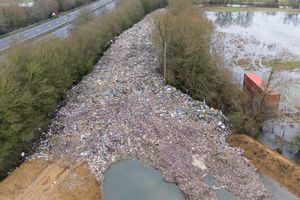 Fly-tippers to be forced to join 'clean-up squads' - and made to 'pick up the bill'
 Rwanda demands more than £100m from UK over failed migrant deportation deal