
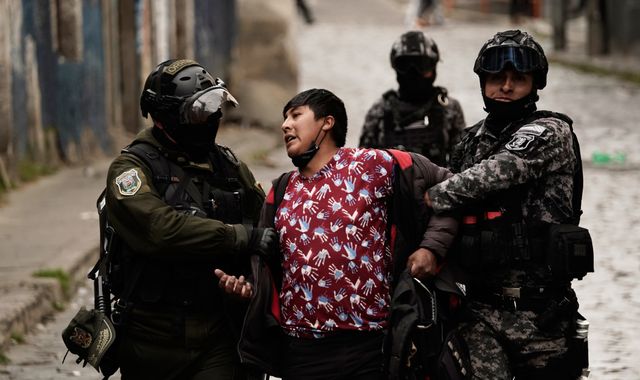
International concern has been growing following weeks of nationwide protests in Bolivia - with the country's president saying he will reshuffle his cabinet in response to the unrest.
At least three people have died, Bolivia's government has said, after emergency vehicles were blocked from reaching medical centres following two weeks of road closures caused by demonstrations in the capital La Paz.
The disruption, coming amid protests over austerity measures and rising living costs, has impacted supplies, with banks closing, markets emptying and hospital oxygen reserves being depleted.
On Monday, supporters of Bolivia's former president, Evo Morales, clashed with police as they joined groups from multiple sectors demanding the resignation of the current president, Rodrigo Paz.
Mr Paz, a centrist who has been in office for six months after decades of socialist rule, warned last week that "those seeking to destroy democracy will go to jail".
Mr Paz also said he was going to "reorganise the cabinet" in response to the upheaval, adding: "The president cannot be
everywhere, the president cannot solve all the problems."
However, he did not give a timeline for the changes or specify exactly what the reshuffle would entail.
'Sliding toward extremism'
Tensions have been high in the South American nation for weeks as protests that began with strikes in early May have grown into a nationwide movement involving labour unions, miners, transport workers and rural groups.
Colombia President Gustavo Petro described the unrest in the country as "popular insurrection".
Mr Petro, responding to Bolivia's foreign ministry asking the Colombian ambassador to leave, citing "sovereignty concerns", said Bolivia was "sliding toward extremism".
He also reiterated that Colombia was willing to serve as a mediator to facilitate a dialogue between the opposing sides.
Mr Paz later said he considered Mr Petro's conduct "reproachable".
US condemns riots
Eight allied Latin American governments, including Chile and Costa Rica, released a joint statement rejecting "any action aimed at destabilising the democratic order".
Meanwhile, Argentina said it would begin a week-long humanitarian operation to alleviate shortages in the country.
The European Union and a number of European embassies have also called for peaceful demonstrations.
Read more from Sky News:
Suspected Ebola cases reach 600 and more expected
Former Cuba president charged with murder in the US
The US, looking to rebuild relations with Bolivia, said it backed Mr Paz's efforts "to restore order for the peace, security and stability of the Bolivian people".
Christopher Landau, the US deputy secretary of state, said he had affirmed Washington's support for the Bolivian president, condemning the blockades and riots and claiming the organisers have the backing of organised crime and drug traffickers.

(c) Sky News 2026: Weeks of unrest in Bolivia causes widespread disruption - and forces president to reshuffle
 Are Reform a bigger threat to Labour or the Conservatives? Here's what local election results tell us
 Radio station apologises after accidentally announcing King's death
 UK to provide up to £20m for fight against Ebola outbreak in Democratic Republic of the Congo and Uganda
 Aston Villa win Europa League to claim first major trophy in 30 years
 Murder investigation launched after bus driver dies following assault on a London bridge
 Man arrested for offences linked to huge illegal waste site in Wigan