The removal of mummified Egyptian remains from display at two Glasgow museums has sparked a lively debate - is it "woke madness" or the decent and "ethical" thing to do?
Kelvingrove Art Gallery and Museum has removed the mummified corpse of a priest named Nekht, a mummified right hand recovered from the Valley of the Kings in Luxor, a mummified male head and a mummified right foot.
Charity Glasgow Life, which manages the space on behalf of Glasgow City Council, said the removal of human remains from public display "reflects contemporary museum practice" in light of a lack of "consent from the deceased".
The Hunterian, which is managed by the University of Glasgow, will also no longer put human remains from outside the UK on open display as part of its "commitment to becoming a more ethical institution".
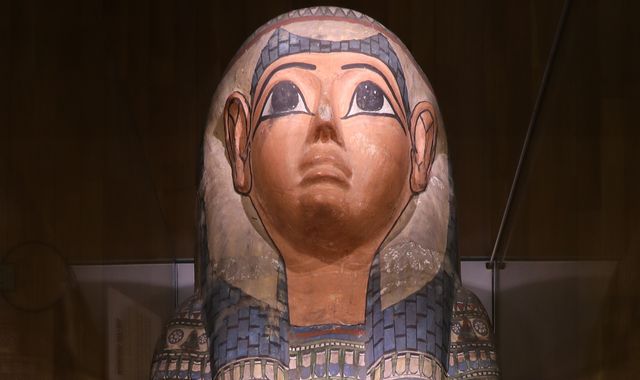
Reflecting that decision, the mummified body of Lady Shep-en-hor - which has been in its collection since 1820 and is within a semi-opened sarcophagus - has been covered up as the museum says she "deserves privacy in death".
'Woke madness'
Immediate reactions were harsh, with Scottish Tory MSP Murdo Fraser branding the decisions "woke madness at its most ridiculous".
Mr Fraser added: "Glasgow's museums should be showcasing our history, not quietly removing it to appease the latest trend in political correctness."
Reform UK Scotland MSP Thomas Kerr also posted a video describing the removal at Kelvingrove as "bonkers" and "left-wing politics gone nuts".
However, the chair of Egyptology Scotland has told Sky News the decision reflects changes in legislation that emphasise human remains "should not be classed as objects".
Egyptology Scotland, which was formed in 2000, aims to promote the study and understanding of ancient Egypt in Scotland.
Chairperson Claire Gilmour said the decisions are not without precedent, highlighting a recent similar removal of a mummified body at Manchester Museum.
She said: "Over the last decade or so, conversations around the display of Egyptian mummified remains have centred around how to do this ethically and sensitively.
"Many museums hold these remains as a result of 19th and early 20th century collecting, and policies have evolved to reflect contemporary discomfort around those practices.
"Press coverage has focused on the 'consent' aspect of being displayed, but this is part of a much wider issue.
"Changes in legislation emphasise that human remains should not be classed as objects.
"The ethical storage, use, and display of such remains includes practices such as giving them separate space, signage to indicate that visitors are about to see them, and information on the processes which led to the remains being in their current location.
"Museums hold collections in trust for the future, and changes in social attitudes may necessitate revision in policies, but this move has been carried out in good faith and is not irreversible."
'Museums exist partly to bring history to life'
Kelvingrove visitor Jonny McFarlane said his young daughter had become "quite animated" about a book on ancient Egyptians, so earlier this month he decided to take her to the museum to see Nekht.
However, instead of the mummy exhibit, a card read: "We have removed human remains from this display as a mark of respect."
Mr McFarlane told Sky News: "We were looking forward to it, and she was wondering why it wasn't there after I had told her it was.
"It's quite a hard thing to explain to a five-year-old. She was satisfied enough with what was there though. At her age, they move on quickly to the next excitement."
Mr McFarlane believes the removal is a "mistake".
He added: "I'm not particularly interested in turning it into another culture war argument because those debates tend to generate more heat than light.
"My view is much more pragmatic: museums exist partly to bring history to life and exhibits like this have fascinated generations of children and adults."
What the museums have to say
Glasgow Life manages a number of other venues in the city, including the Riverside Museum, The Burrell Collection, and the Gallery of Modern Art.
A spokesperson for the charity said: "The removal of human remains from display at Glasgow Life museums reflects contemporary museum practice.
"The International Council of Museums' revised code of ethics, published in June 2026, states that 'museums should uphold the inherent dignity of human remains and promote respect for their significance'."
The spokesperson added: "Glasgow Life Museums' draft human remains policy proposes that human remains should only be displayed where there is documented and informed consent from the deceased individual or, in appropriate circumstances, their descendants.
"In the absence of such consent, we believe removing ancient Egyptian human remains from display is more respectful to the deceased individuals."
The Hunterian said Lady Shep-en-hor has never been unwrapped or subjected to destructive analysis but has been X-rayed and CT-scanned in the last 50 years.
In the 1970s, questions were raised about whether the remains in the coffin were actually those of Lady Shep-en-hor.
The Hunterian said excavators in the 19th century occasionally swapped over remains from different coffins, with better preserved specimens placed in the most intact sarcophagi.
A spokesperson for The Hunterian said: "As part of its commitment to becoming a more ethical institution, The Hunterian at the University of Glasgow is considering its holdings of archaeological and anatomical human remains across all sections of its collections.
"Human remains are among those items which The Hunterian seeks most keenly to return to their communities and nations of origin.
"The Hunterian is also reassessing what will be on display to the general public and as part of its duty for the respectful care of these collections, it has decided to no longer put human remains from outside the UK on open display."
Elsewhere, National Museums Scotland (NMS) said it is "not currently planning any changes" to the display of human remains in its collection.

(c) Sky News 2026: Debate unfolds over removal of mummified Egyptian remains from Glasgow museums
 Pair charged over RAF Fairford incident - with suspect accused of assisting Iranian intelligence
 Poundland close to collapse as new directors head for exit
 Flavio Bolsonaro: Defeated Brazilian presidential candidate 'ordered to hand over passports'
 Woman dies in sea off Isle of Wight - as search suspended for man in Scotland
 At least 62 killed and thousands displaced in gunmen attack in northern Nigeria
 South Africa: More than 500 troops sent to deal with anti-immigration protests in KwaZulu-Natal
 Virgin Atlantic fury as Heathrow forces Delta terminal move
 Ebola cases in Democratic Republic of Congo surpass 10,000 as nurse treating patients is killed by mob