

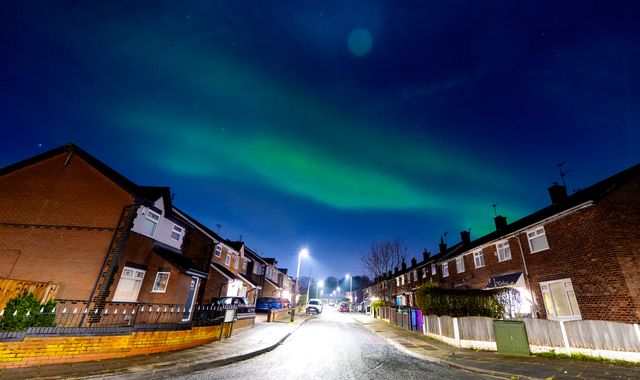
People across the UK could be in with a chance of seeing the Northern Lights today and tomorrow following solar activity yesterday.
A fast, Earth-directed coronal mass ejection - a burst of solar plasma and magnetic fields - was launched from the sun early yesterday, Sky News weather presenter Joanna Robinson explained.
It is expected to reach Earth today, with aurora sightings possible in the north of the UK tonight, although this could be obscured by cloud.
There's a slight chance of sightings across central England and Wales, too, where clearer skies are expected.
The Northern Lights may also be seen on Friday night, although more cloud and rain moving in from the southwest may limit any opportunity to see the aurora tomorrow.
The Met Office believes that various ejections from multiple solar flares may combine, before giving Earth a "glancing blow" on Friday.
What causes the Northern Lights?
The shimmering spectacle occurs when energy and charged particles released from the sun through what are known as coronal mass ejections, and solar flares, travel towards Earth on the solar wind and collide with the Earth's magnetic field and upper atmosphere, interacting with gases to create spectacular displays of blue, purple, green, pink and red.
If the solar activity is strong enough, it will cause a geomagnetic storm.
Why are such displays rare?
The UK does experience auroras on occasion.
In March, parts of the UK enjoyed breathtaking views of the Northern Lights.
But the auroras are most common over high polar latitudes.
However, even when present, the phenomenon can be notoriously hard to spot with the naked eye - even in countries such as Norway and Iceland, where sightings are more common.
Read more from Sky News:
Marco Rubio says Greenland is part of Denmark 'for now'
Man shot with crossbow at university accommodation site
According to the Royal Observatory Greenwich, different gases determine what colours light up the sky, with nitrogen and oxygen being the primary gases in Earth's atmosphere.
Green in the aurora is a characteristic of solar energy interacting with oxygen, while purple, blue or pink hues are caused by nitrogen.
A deep red can sometimes be seen when the aurora is "particularly energetic", as a result of very high-altitude oxygen interacting with solar particles.

(c) Sky News 2026: Sighting of Northern Lights possible across the UK tonight - these are the best places to see
 Three Royal Navy members who died in helicopter crash in Devon named
 Man in his 50s taken to hospital after crossbow shooting at University of Surrey accommodation
 Andoni Iraola named as Liverpool's new head coach
 Murder investigation after boy dies following Saturday stabbing
 Brothers jailed after teenage boy run down and killed
 Ex-police officer falsely identified by Grok in Henry Nowak arrest is forced to flee
 FIFA 'regrets' free World Cup tickets and demands fans pay up
 British 'mafia boss' Steven Lyons kidnapped by law enforcement, lawyer claims, after capture in Bali and deportation to Amsterdam